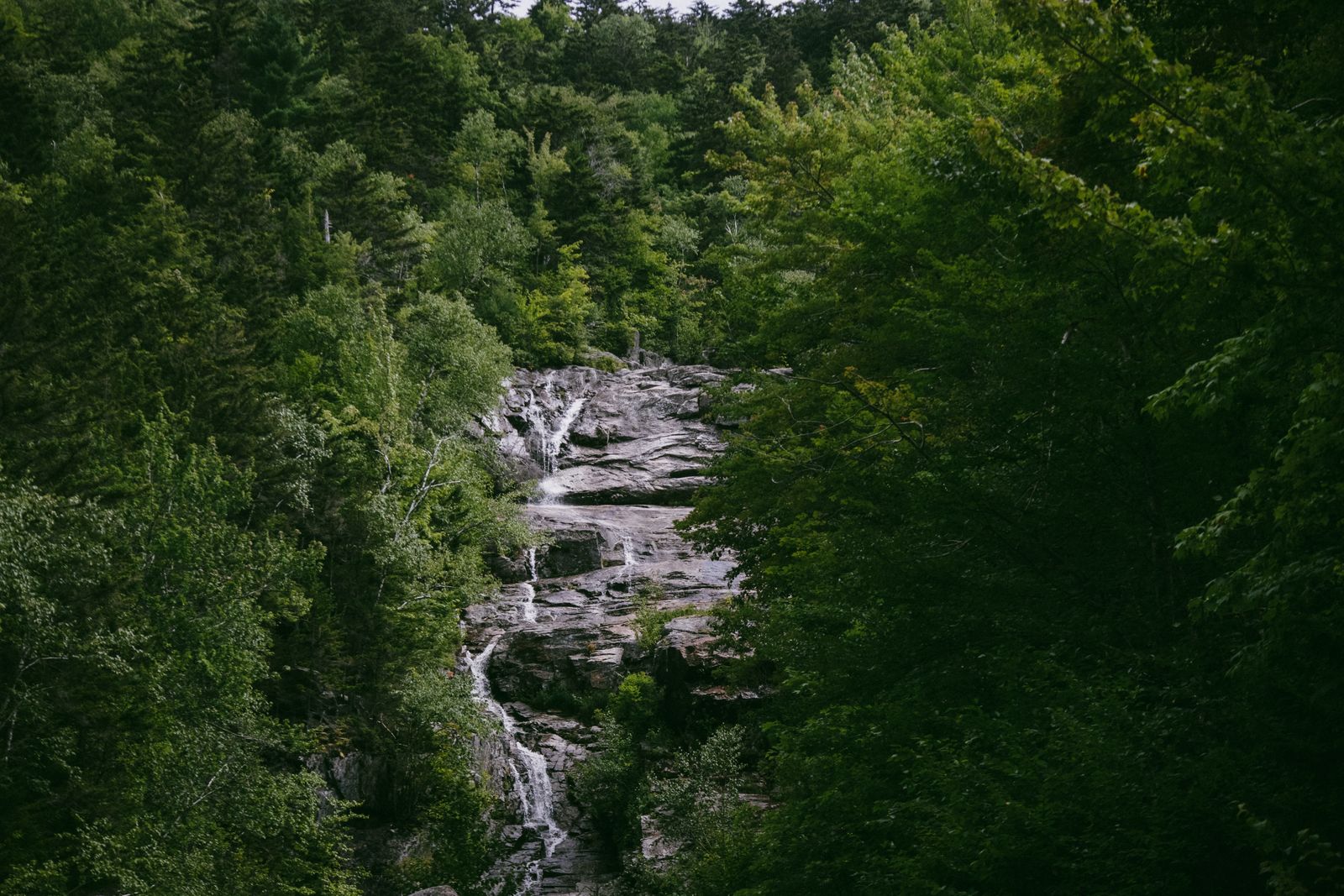
Vermont’s Little Grand Canyon
Eight miles east of Woodstock village on Route 4, the ground simply drops away. Quechee Gorge plunges about 165 feet to the Ottauquechee River below — the deepest gorge in Vermont, and a genuinely startling sight to come upon at highway speed.
The geology is glacial. Roughly 13,000 years ago, as the last ice sheet retreated, meltwater from a large glacial lake was forced through this point and cut down through the bedrock with extraordinary speed, leaving a narrow, steep-walled chasm rather than the broad valley a river would normally carve. The result is a slot of dark schist walls, hemlock clinging to the rim, and a river running fast and green at the bottom.
What makes it unusual as an attraction is the access. The Route 4 highway bridge crosses directly over the gorge, and a pedestrian sidewalk runs its full length, which means the single best view is free, requires no walking and is available to anyone who can park. From the middle of the span you look straight down the length of the chasm — vertigo-inducing, and the most photographed roadside view in the county.
Walking the gorge
The view from the bridge is the postcard, but the gorge rewards getting into it.
The Quechee Gorge Trail leaves from near the visitor centre on the south side of Route 4 and descends about 0.7 miles to the river floor — a gentle, well-graded path through hemlock and birch with switchbacks and steps, roughly 1.4 miles round trip. At the bottom you reach a broad gravel bar where the water slows, good for wading, fishing for trout and looking back up at 165 feet of rock. Allow forty minutes to an hour with stops.
North of the bridge, a shorter path follows the rim upstream to the old Dewey’s Mills dam and pond, a quieter walk with views over a reclaimed millpond and wetland now managed for wildlife. Herons, kingfishers and beaver are all regular.
Quechee State Park, on the south rim, holds the campground, picnic areas and the trail network. It is Vermont’s smallest state park by acreage but one of its most visited, with tent sites and lean-tos, restrooms and easy family walking. A modest day-use fee applies at the park; the bridge sidewalk and gorge trail are free.
Two cautions. The rim has unfenced sections beyond the bridge, and the rock is slick when wet — stay on the marked path with children. And the river below is not a swimming hole in high water; spring runoff turns it powerful and cold.
Simon Pearce
A mile west, in Quechee village, the river drops again over a low falls, and above it stands the reason many visitors come: Simon Pearce, in the restored Downers Mills woolen mill.
The story is unusual for Vermont. Simon Pearce, an Irish glassblower from a Quaker pottery family, came looking in the 1980s for a site with cheap power for the furnaces that glassmaking demands. He found a derelict 19th-century mill with an intact water right on the Ottauquechee, restored it, and installed a hydroelectric turbine that still generates the electricity running the glass shop below. It is a genuinely closed loop: the river powers the furnaces that melt the glass.
Downstairs, a viewing gallery looks directly into the working glass studio. Master glassblowers gather molten glass from the furnace on the end of a blowpipe and turn it into stemware, pitchers and bowls in a few minutes of continuous motion — the most compelling free thing to watch in Vermont, and different every time. Potters work alongside them. The retail floor above sells the finished pieces, which are simple, heavy and unmistakable.
The restaurant occupies the mill’s upper floor, with floor-to-ceiling windows and a deck directly over the falls. It serves farm-to-table cooking on the company’s own glass and pottery, and the combination of the water noise, the view and the plates makes it one of the most memorable meals in the state. Book ahead for dinner and for foliage weekends; lunch is easier.
Quechee village and around
The village itself is small and worth a slow half-hour. A covered bridge — rebuilt after Tropical Storm Irene destroyed the original in 2011 — crosses the river beside the mill, and the millpond above it reflects the whole scene. The Quechee Inn at Marshland Farm, a 1793 farmhouse, sits nearby.
Just east on Route 4, Quechee Gorge Village is a large complex of antique dealers, a country store, a diner and the Cabot Quechee Store, plus a vintage carousel and a toy museum — unashamedly touristic, but a genuinely deep antiques market with hundreds of dealer booths under one roof.
The Vermont Institute of Natural Science, on the south side of Route 4, is the area’s underrated attraction: a raptor centre and nature campus with resident bald eagles, owls, hawks and falcons that cannot be returned to the wild, plus daily flight demonstrations, forest canopy walks and excellent programming for children. Allow ninety minutes.
And the Ottauquechee itself is fishable and paddleable above and below the gorge, with put-ins near Dewey’s Mills and downstream toward Hartland.
A half-day plan
The most efficient route through the area.
Start at the bridge — park at the visitor centre lot and walk the Route 4 sidewalk for the free overhead view down the chasm.
Hike to the river — 0.7 miles down the Quechee Gorge Trail to the gravel bar, 1.4 miles round trip, forty minutes to an hour.
Walk the rim north — the shorter path to the Dewey’s Mills pond and wetland for birdlife and a quieter view.
Watch the glassblowers — the free viewing gallery at Simon Pearce, a mile west in the village, above the falls.
Eat over the water — lunch or dinner at the Simon Pearce restaurant, on the mill’s upper floor with a deck over the falls.
Add the raptors — the Vermont Institute of Natural Science for eagles, owls and daily flight demonstrations, ninety minutes.
Finish in the antiques — Quechee Gorge Village’s dealer booths and the Cabot store, five minutes east on Route 4.
Seasons and logistics
Quechee sits on US Route 4 at the eastern edge of Windsor County, three miles from I-89 at exit 1 and eight miles east of Woodstock — about 100 minutes from Burlington and two hours from Boston. Parking at the gorge is free at the visitor centre and state park lots, and it fills fast in October.
Autumn is the peak. Foliage in the river valley usually reaches full colour between 1 and 12 October, and the gorge framed in red maple is one of Vermont’s defining images — expect crowds on the bridge and queues at the restaurant. Summer is warm and green, best for the trail to the river and the picnic areas. Spring runoff makes the gorge loudest and most dramatic, though the trail can be muddy. Winter is quiet and striking, with ice on the walls and the falls partly frozen; the trail requires traction and the state park closes, but the bridge view stays open all year.
Allow half a day for the whole area, or a full day if you add the raptor centre and the antiques.
For lodging, the Quechee Inn at Marshland Farm and a cluster of mid-range hotels and motels along Route 4 near the gorge run around 175 to 230 a night — reliably cheaper than Woodstock eight miles west, with the same access. Quechee State Park offers camping and lean-tos. Compare live prices in the search below, with free cancellation on most rooms.
Good to know
Common questions
How deep is Quechee Gorge?
About 165 feet, making it Vermont’s deepest gorge. It was cut roughly 13,000 years ago when meltwater from a retreating glacial lake was forced through this point and sliced down through bedrock, leaving a narrow slot rather than a broad valley.
Can you see Quechee Gorge for free?
Yes — the best view is free. A pedestrian sidewalk runs the full length of the Route 4 highway bridge directly over the gorge, so you can look straight down the chasm with no walking and no fee. Parking at the visitor centre lot is also free.
Can you hike into the gorge?
Yes. The Quechee Gorge Trail descends about 0.7 miles from near the visitor centre to a gravel bar at the river — 1.4 miles round trip on a well-graded path with steps, taking forty minutes to an hour. A shorter rim path runs north to the Dewey’s Mills pond.
What is Simon Pearce?
A glassworks in a restored 19th-century woolen mill above the falls in Quechee village. Its own hydroelectric turbine, driven by the Ottauquechee, powers the furnaces. A free gallery looks into the working studio, and the restaurant upstairs has a deck directly over the falls.
What else is there to do in Quechee?
Watch glassblowing and eat over the falls at Simon Pearce, visit the Vermont Institute of Natural Science for resident eagles, owls and daily raptor flight demonstrations, and browse the hundreds of antique dealer booths at Quechee Gorge Village.
Every booking through Vermont Destinations funds one verified tonne of carbon removal — same room, same price, no markup.
Find a stay