Where Vermont fought for itself
Bennington was the first town chartered in what would become Vermont, in 1749, and for its first three decades it was the centre of a land dispute that shaped the state’s character. New Hampshire had sold the grants; New York claimed the territory; and the settlers, organised as the Green Mountain Boys under Ethan Allen and Seth Warner, met in the town’s taverns to plan resistance to both.
The Catamount Tavern on the hill in Old Bennington was their headquarters, and from here the Boys rode to seize Fort Ticonderoga in 1775. When the Revolution reached Vermont in earnest, Bennington became a supply depot — and a target.
What survives is a hilltop of Colonial and Federal architecture, a 306-foot monument, one of the finest churchyards in New England, and a museum holding the largest public collection of a painter who did not begin painting until she was almost eighty. It makes for a full and unusually varied day.
The Battle Monument
The Bennington Battle Monument rises 306 feet above Old Bennington and is the tallest man-made structure in Vermont. Built between 1887 and 1889 of blue-grey magnesian limestone quarried at Sandy Hill, New York, it was dedicated in 1891 on the centenary of Vermont’s statehood, and it marks the site of the supply depot the British were sent to capture.
The battle it commemorates was fought on 16 August 1777, several miles west across the New York line. Brigadier General John Stark, leading New Hampshire militia alongside Warner’s Vermont Continentals, defeated a detachment of General Burgoyne’s army under Lieutenant Colonel Baum, killing or capturing almost the entire force. The loss cost Burgoyne his supplies and roughly a tenth of his men, and contributed directly to his surrender at Saratoga two months later — the turning point that brought France into the war.
An elevator carries visitors to an observation level at 200 feet, with views over three states: the Green Mountains east, the Taconics west into New York, and Mount Greylock south in Massachusetts. It is open seasonally, roughly mid-April through October, for a small admission fee. The grounds, with their statue of Seth Warner, are free and open year-round.
Bennington Battle Day, 16 August, remains a legal state holiday in Vermont — one of very few states to observe a Revolutionary battle in this way.
Old Bennington and Robert Frost’s grave
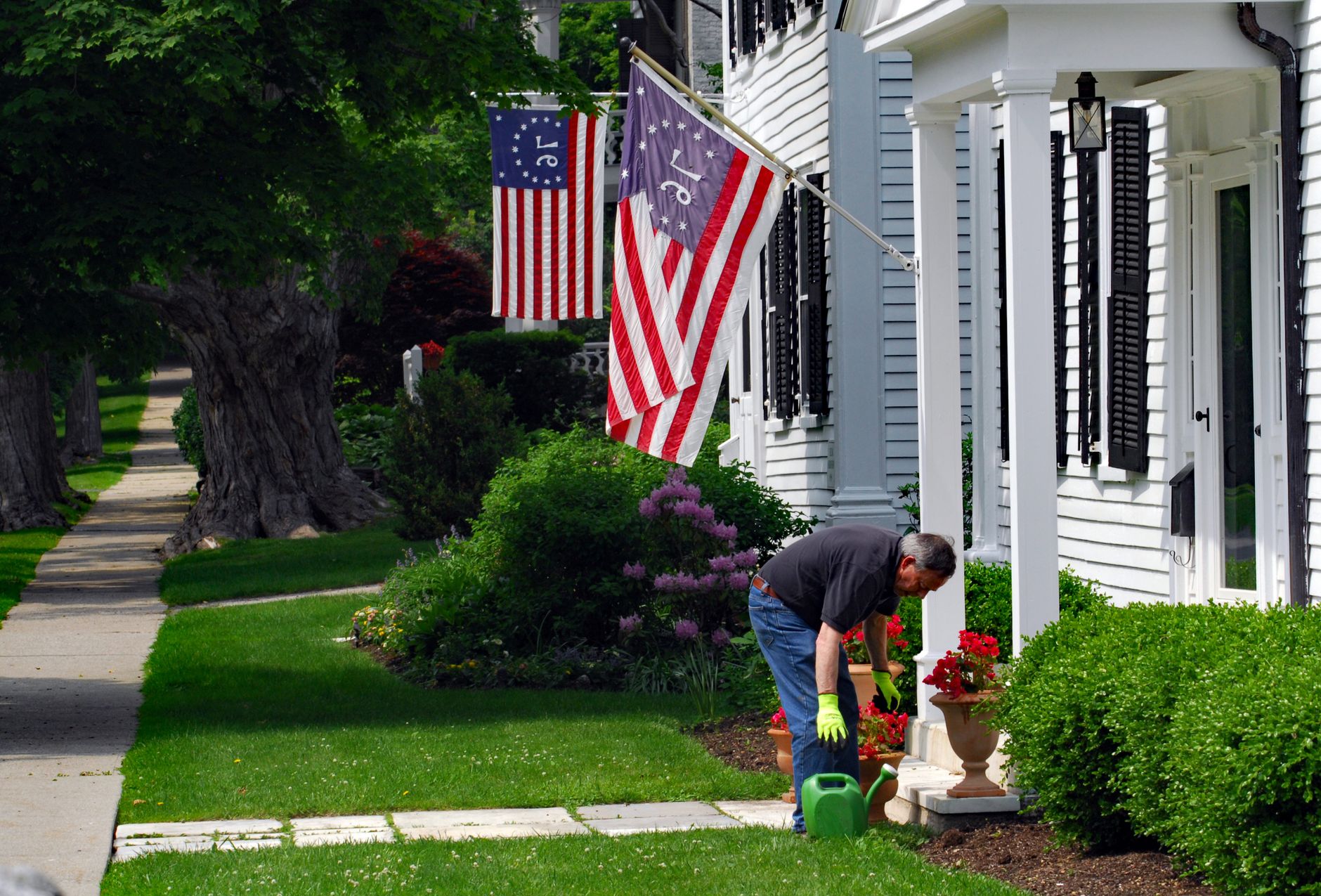
The monument stands in Old Bennington, the original hilltop settlement, which is now a conservation district of some of the best-preserved Colonial and Federal houses in the state — white clapboard and brick, set back behind stone walls along a single broad street.
Its centre is the Old First Congregational Church, dedicated in 1806 and widely regarded as one of the finest church buildings in New England: a Palladian-influenced meeting house with a three-stage tower, box pews and original glass. It calls itself Vermont’s Colonial Shrine, and it is open to visitors in season.
In the churchyard behind it lies the poet Robert Frost, who spent much of his adult life in Vermont and taught nearby. He and members of his family are buried in a simple family plot, his stone carrying the epitaph he chose for himself — a line about having had a lover’s quarrel with the world. The graveyard also holds the remains of soldiers killed in the 1777 battle, and stones dating to the 1760s.
The churchyard is free, open and quiet. It repays a slow half-hour: the stonecutting on the 18th-century markers, with their winged death’s heads and willow motifs, is a study in early American folk art in its own right.
Grandma Moses and the Bennington Museum
The Bennington Museum, on West Main Street between Old Bennington and downtown, is the county’s cultural anchor and holds a collection out of all proportion to the town’s size.
Its centrepiece is the world’s largest public collection of paintings by Anna Mary Robertson Moses, known as Grandma Moses. A farm wife from just across the New York line, she took up painting in her late seventies after arthritis made embroidery too painful, was discovered by a collector who saw her work in a drugstore window, and became internationally famous in her eighties — showing in New York, Paris and Vienna, and painting until her death at 101. The museum displays dozens of works alongside the schoolhouse she attended, moved to the site, and her paint table.
The museum also holds the Bennington Flag, one of the oldest surviving Stars and Stripes; a major collection of Bennington pottery and stoneware from the town’s 19th-century potteries; early American glass and furniture; a 1925 Wasp luxury car, the only one of its kind, built in Bennington; and rotating exhibitions of Vermont modernism and regional art.
Allow ninety minutes to two hours. It is open most of the year, with a small admission fee, and is one of the best rainy-day options in southern Vermont.
Downtown, pottery and the bridges
Downtown Bennington, below the hill, is a working small city rather than a preserved village, and it is the better place to eat. Its brick Main Street holds cafes, breweries, a co-op, bookshops and the restored 1930s Bennington Center for the Arts nearby.
Bennington Potters, founded in 1948, still produces its distinctive speckled stoneware in the town’s pottery tradition. The Potters Yard on County Street offers behind-the-scenes tours of the works, a large outlet shop and a cafe — the best souvenir stop in the county.
North of town, three historic covered bridges cross the Walloomsac River within an easy loop. The Silk Road Covered Bridge of 1840, at 88 feet, is the oldest standing in the county, a Town lattice truss with weathered red siding and open eaves. The Paper Mill Village Bridge, 125 feet and rebuilt in 1889, stands on the site of Vermont’s first paper mill, established in 1784. And the Henry Covered Bridge of 1840, 121 feet, was completely dismantled and rebuilt in 1989 using historic timber-framing methods, with a small public park beside it for picnics and river access.
Also worth the drive: the Robert Frost Stone House Museum in nearby Shaftsbury, where Frost wrote Stopping by Woods on a Snowy Evening, and the Park-McCullough House in North Bennington, a 35-room 1865 Second Empire mansion with original furnishings.
A full-day plan and practical notes
Everything sits within a few miles, which makes for an efficient day.
Morning — Old Bennington: the Battle Monument elevator, then the Old First Church and Frost’s grave. Two hours.
Late morning — the Bennington Museum for Grandma Moses, the Bennington Flag and the pottery collection. Ninety minutes.
Lunch — downtown Bennington on Main Street, or the cafe at the Potters Yard.
Afternoon — Bennington Potters tour and outlet, then the Walloomsac covered bridge loop: Silk Road, Paper Mill and Henry.
Add-on — the Robert Frost Stone House Museum in Shaftsbury, or the Park-McCullough House in North Bennington.
Seasons — the monument elevator runs mid-April to October; foliage peaks in the first half of October; the museum and churchyard work year-round.
Getting here and where to stay
Bennington sits at the junction of US Route 7 and Route 9 in Vermont’s far southwest corner — about 40 minutes from Albany’s airport, two hours from Albany itself is not needed as it is closer than that, three hours from Boston and four from New York City. Route 9, the Molly Stark Byway, runs east to Brattleboro; Route 7 and the scenic Route 7A run north to Manchester in thirty minutes.
Parking in Old Bennington is free along the street near the monument and the church; downtown has metered and lot parking.
For lodging, Bennington itself offers well-priced motels, inns and B&Bs, including several historic houses near the monument, and it is consistently cheaper than Manchester thirty minutes north. Arlington, halfway between the two, adds riverside inns on the Batten Kill. For a splurge, the Equinox in Manchester Village is the grand option. Compare live prices in the search below, with free cancellation on most rooms.
Good to know
Common questions
How tall is the Bennington Battle Monument?
306 feet, making it the tallest man-made structure in Vermont. Built 1887 to 1889 of blue-grey magnesian limestone and dedicated in 1891, it has an elevator to an observation level at 200 feet with views into Vermont, New York and Massachusetts.
Why does the Battle of Bennington matter?
On 16 August 1777, John Stark’s New Hampshire militia and Warner’s Vermont Continentals destroyed a detachment of Burgoyne’s army sent to seize the Bennington supply depot. The loss cost Burgoyne his supplies and helped force his surrender at Saratoga — the turning point of the Revolution.
Where is Robert Frost buried?
In the churchyard of the Old First Congregational Church in Old Bennington, in a simple family plot. His stone carries the epitaph he chose about having had a lover’s quarrel with the world. The churchyard is free and open, and also holds soldiers from the 1777 battle.
Who was Grandma Moses?
Anna Mary Robertson Moses, a farm wife who began painting in her late seventies when arthritis ended her embroidery, became internationally famous in her eighties and painted until she died at 101. The Bennington Museum holds the world’s largest public collection of her work.
What covered bridges are near Bennington?
Three over the Walloomsac River north of town, in an easy loop: the 1840 Silk Road Bridge at 88 feet, the oldest in the county; the 125-foot Paper Mill Village Bridge, rebuilt 1889 on the site of Vermont’s first paper mill; and the 121-foot Henry Bridge, rebuilt in 1989 by traditional methods.
Every booking through Vermont Destinations funds one verified tonne of carbon removal — same room, same price, no markup.
Find a stay