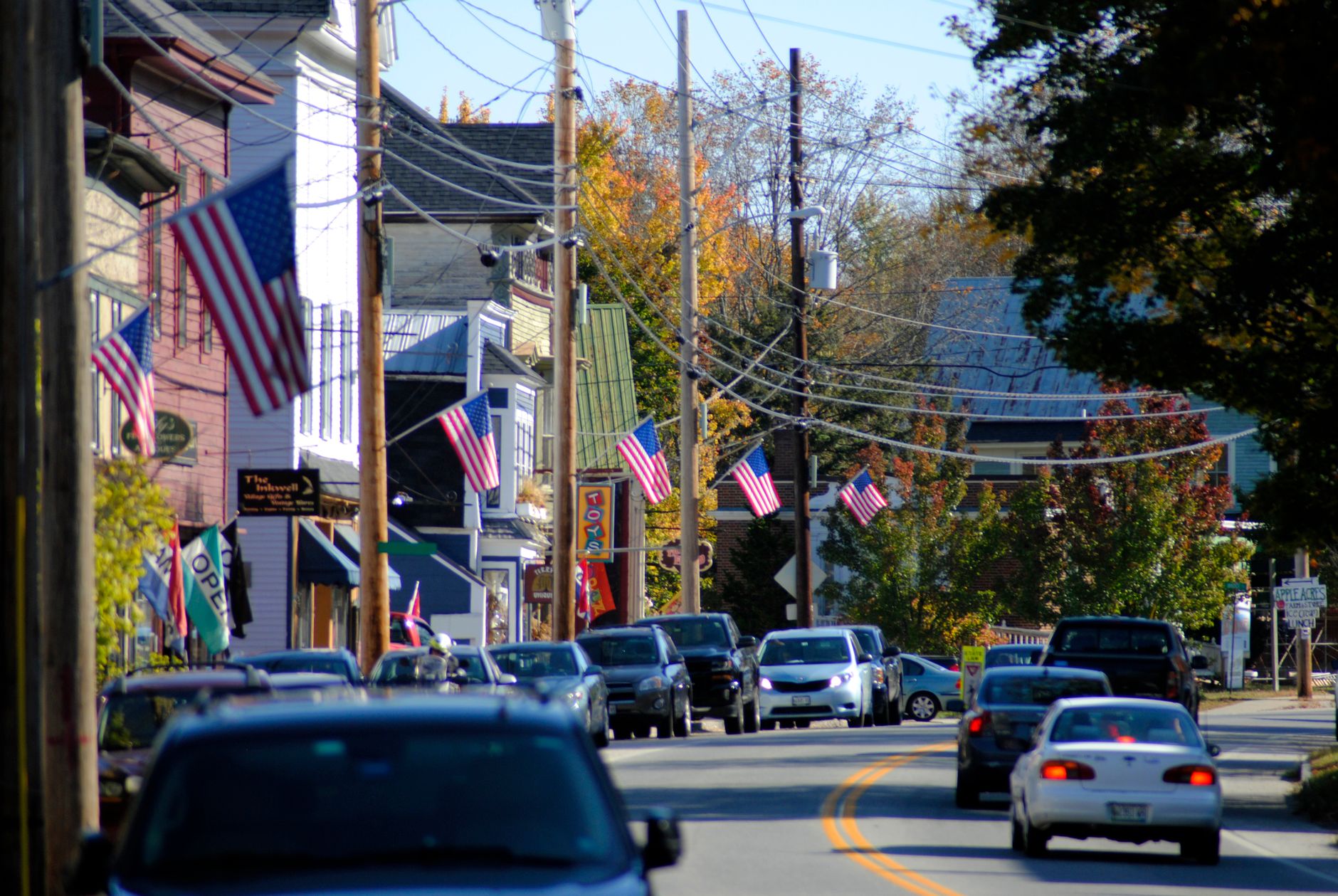
Southern Vermont’s creative capital
Brattleboro has a character entirely its own, and it does not much resemble the rest of Vermont. It is progressive, artsy, a little ramshackle and proudly independent — a river town of about 12,000 people where a food co-op anchors the downtown, buskers play on Main Street, and the brick blocks step down toward the Connecticut River in a way that feels more mill-town New England than picture-postcard Vermont.
That character has roots. Brattleboro was the first permanent English settlement in Vermont, established at Fort Dummer in 1724, and it grew as an industrial and publishing centre — the Estey Organ Company here was once the largest reed organ maker in the world. In the 19th century it also became a wellness destination, drawing thousands to a water-cure spa on the hill. The counterculture arrived in the 1960s and 70s and never left, which is why the town today reads as a genuine artists' community rather than a curated one.
The result is the most interesting small town in southern Vermont: excellent food, real galleries, a working co-op, live music most nights, and enough grit to keep it honest.
Gallery Walk and the museum
The town’s signature event is Gallery Walk, a first-Friday art crawl through dozens of downtown venues — galleries, cafes, shops, banks, the library — that has run for over two decades. Artists show, musicians play on street corners, and the whole town comes out onto the pavement. It runs year-round and is free.
The Brattleboro Museum & Art Center occupies the restored 1915 Union Station on the waterfront, and it works differently from most regional museums: it holds no permanent collection at all, showing only rotating contemporary exhibitions across several galleries. That makes every visit different, and the programming is more adventurous than a town this size has any right to expect.
The Latchis Theatre on Main Street is the other landmark, and it is remarkable. Built in 1938 by a Greek immigrant family, it is one of very few surviving art-deco theatre-and-hotel complexes in the United States, with terrazzo floors, a mural cycle of Greek mythology, zodiac ceiling decoration and a still-operating four-screen cinema. The attached hotel is a working, affordable place to stay in the middle of downtown.
Add the Hooker-Dunham Theater, the Stone Church music venue in a converted 1870s church, and the Vermont Jazz Center, and there is live performance most nights of the week.
Eating, drinking and the co-op
Brattleboro punches far above its size at the table, and it is the best eating in Windham County.
TJ Buckley’s is the landmark: an upscale kitchen in a restored 1920s Worcester diner car with eighteen seats, where the chef cooks a short changing menu in full view. Booking is essential. Whetstone Beer Co. sits above the Whetstone Brook and the Connecticut with a big deck, house beer and a good kitchen. Add Nepali and Vietnamese kitchens, a serious bakery culture, several coffee roasters and a strong late-night scene, and you can eat well for a week.
The Brattleboro Food Co-op is the civic heart as much as a grocery: community-owned since 1975, a large modern store with bulk bins, a deli and hot bar, local produce and a deep cheese counter. Locals shop here daily, and it is the best place in town to assemble a picnic.
The Saturday farmers' market, on Route 9 west of downtown, runs May through October in a wooded park setting along the brook, with live acoustic music, French pastries, Malian cooking and wood-fired pizza from a mobile brick oven — one of the two or three best markets in Vermont.
Around the town
Brattleboro is compact and walkable, but the surroundings repay a day.
The Retreat Farm, just north, is a 500-acre working farm and non-profit with trails, a farmstead animal barn and food trucks in summer, on land that once belonged to the Brattleboro Retreat — the pioneering 1834 psychiatric hospital that shaped the town. The Retreat Trails run nine miles through its woods, free and open, including a stone tower on the hill.
Just across the Connecticut in New Hampshire, the Wantastiquet Mountain trail climbs to a summit ledge with the best view of Brattleboro and the river valley — about three miles round trip. In town, the Estey Organ Museum tells the story of the company that made 500,000 reed organs here, and the Creamery Covered Bridge on Route 9 west of downtown is a Town lattice span of 1879.
Further out, Putney is ten minutes north — an orchard and craft village with Green Mountain Orchards, Basketville and a strong potters' community. Marlboro is fifteen minutes west on Route 9, home of the Marlboro Music Festival, a celebrated summer chamber music gathering. And Hogback Mountain’s 100-Mile View is twenty minutes west on the same road.
A day in Brattleboro
A workable plan for one full day.
Morning — coffee and pastry downtown, then the Brattleboro Museum & Art Center in the 1915 Union Station on the waterfront.
Late morning — walk Main and Elliot Streets: independent bookshops, galleries, record stores and the Latchis Theatre lobby.
Lunch — the Brattleboro Food Co-op hot bar and deli, or Whetstone Beer Co. on its deck above the river.
Afternoon — the Retreat Trails and Retreat Farm, or climb Wantastiquet Mountain across the river for the view back over town.
Late afternoon — the Estey Organ Museum, or drive west on Route 9 to the Creamery Covered Bridge and on to Hogback’s 100-Mile View.
Evening — dinner at TJ Buckley’s, booked ahead, then live music at the Stone Church or a film at the Latchis.
First Friday — if your timing allows, Gallery Walk is the single best evening in town.
Practical information and where to stay
Brattleboro sits at exit 1 and 2 of I-91 in Vermont’s southeastern corner, about two hours from Boston, three and a half from New York and two hours south of Burlington. Route 9, the Molly Stark Byway, runs west to Wilmington and Bennington; Route 30 heads north into the West River valley; Route 5 follows the Connecticut.
It is one of very few Vermont towns you can reach and enjoy without a car. Amtrak’s Vermonter stops downtown, intercity buses run from Boston and New York, and the whole centre is walkable. You will want a car for the ski areas, the villages and the reservoirs.
Every season works here, which is unusual in Vermont. Foliage in the first half of October is busiest; winter fills with skiers passing through to Mount Snow and Stratton, thirty and forty minutes west; summer brings the market, the farm and the river; and even stick season keeps the galleries, theatres and restaurants going at the lowest rates of the year.
For lodging, the Latchis Hotel in the art-deco complex is the characterful downtown choice and genuinely affordable; there are mid-range hotels near the interstate exits, bed-and-breakfasts in the hill neighbourhoods, and camping at Fort Dummer State Park just south of town. Compare live prices in the search below, with free cancellation on most rooms.
Good to know
Common questions
What is Brattleboro known for?
Its arts scene: the first-Friday Gallery Walk through dozens of downtown venues, the Brattleboro Museum & Art Center in a 1915 railway station, the 1938 art-deco Latchis Theatre, a community-owned food co-op and one of Vermont’s best farmers' markets.
What is Gallery Walk?
A free first-Friday art crawl through dozens of downtown Brattleboro galleries, cafes, shops and public buildings, running year-round for over two decades. Artists exhibit, musicians play on street corners and the whole town turns out.
What is the Latchis Theatre?
A 1938 art-deco theatre and hotel complex on Main Street built by a Greek immigrant family — one of very few surviving in the United States — with terrazzo floors, Greek mythological murals, zodiac ceiling decoration, a working four-screen cinema and an affordable hotel attached.
Is Brattleboro walkable?
Very. The compact downtown of shops, galleries, the co-op, restaurants and the riverfront is easily explored on foot, and Amtrak’s Vermonter stops in the centre — making it one of the few Vermont towns you can visit without a car.
Where should I eat in Brattleboro?
TJ Buckley’s, an eighteen-seat upscale kitchen in a restored 1920s diner car, booked ahead; Whetstone Beer Co. on its deck above the river; and the Brattleboro Food Co-op hot bar for the best-value lunch in town.
Every booking through Vermont Destinations funds one verified tonne of carbon removal — same room, same price, no markup.
Find a stay